
How to Identify Africanized Honeybees
While definitive visual identification requires laboratory analysis, understanding their unique nesting habits and defensive patterns can help you spot potential Africanized honeybee colonies.
Betsy Rizzo
5/8/20242 min read
When I first started working around honeybees, I expected "killer bees" to look visually distinct. I pictured them as larger, darker, or more menacing than the gentle European honeybees we usually see pollinating backyard gardens.
My perspective changed the first time I actually encountered a colony that did not behave like the others. What looked like a standard, fuzzy little honeybee turned out to have a completely different temperament.
I quickly realized that identifying Africanized honeybees is not about looking closer at their stripes, but about watching how they interact with their environment.
The Myth of Visual Identification
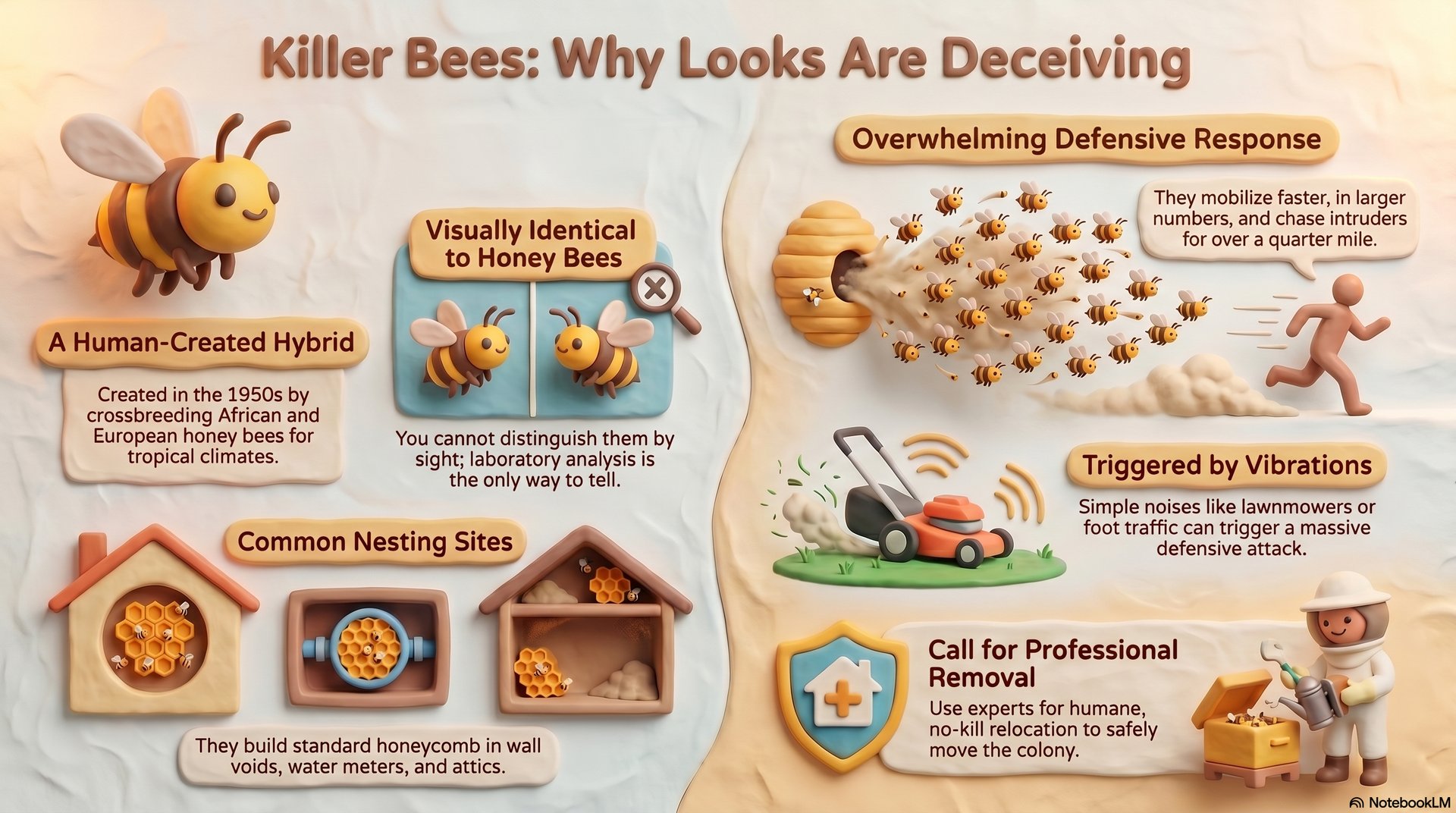
The main challenge is that you cannot visually identify an Africanized honeybee in the field.
Africanized honeybees are hybrids, born from interbreeding between European honeybees and African honeybees. Physically, Africanized bees are actually slightly smaller than European honeybees. However, this difference is so tiny that it is impossible to see with the naked eye.
Trying to measure a bee on a flower is a waste of time. True physical identification can only be done in a laboratory using specific tests. Technicians might use the Fast Africanized Bee Identification System to measure forewing length under a microscope, or run DNA tests to check the queen's genetic lineage. Because we cannot carry lab equipment into the field, we have to rely on behavioral cues.
Behavioral Indicators in the Field
I have always felt that the label "killer bee" is exaggerated. A single Africanized bee does not carry stronger or more toxic venom than a European bee. The real danger, and the way to tell them apart, comes down to how they react as a group.
First, consider their defensive perimeter. With a typical European colony, you can often walk within a few feet of the hive without any trouble. Africanized bees guard a much wider area. Coming within fifty or a hundred feet of their nest can trigger an immediate reaction. They also respond to loud noises, like lawnmowers or weed trimmers, much faster than standard bees.
The scale of their response is also a major giveaway. If you accidentally disturb a European hive, a few bees might fly out to defend it. An Africanized hive responds in massive numbers, sometimes sending thousands of bees to neutralize a perceived threat.
Their persistence is another clear sign. If a European bee chases you away from her hive, she will usually give up after twenty or thirty feet. Africanized bees will chase a target for a quarter-mile or more. If you find yourself running from bees and they refuse to stop, you are likely dealing with Africanized genetics.
You can also look at where they choose to nest. European honeybees are selective, preferring dry, elevated cavities like hollow trees or managed hives. Africanized bees are much less picky. They frequently build nests in water meter boxes, empty flowerpots, discarded tires, or directly on the ground.
Finally, they swarm much more often. A healthy European colony might swarm once a year to split the hive. Africanized colonies might swarm every six weeks, and they will easily abandon their nest entirely if food gets scarce or if they are disturbed.
Respect, Not Panic
Living and working around these bees has taught me that they are not malicious; they are simply highly adapted to survive in harsh environments where threats are constant.
We do not need to panic, but we do need to stay aware. If you live in an area where Africanized bees are common, it is safest to treat any wild, unmanaged colony with caution.
If you notice a hive showing highly defensive behavior, do not try to handle it yourself. Keep your distance and contact a professional removal service. Understanding how they act is our best tool for staying safe.
Contact
Questions about Africanized honeybees? Reach out!
Phone
© 2026. All rights reserved.